

Do hose connectors affect water flow?
Jul 23, 2025
As a dedicated supplier of hose connectors, I've spent countless hours delving into the intricacies of these seemingly simple yet incredibly important components. One question that frequently arises in discussions with customers and industry peers is whether hose connectors have an impact on water flow. In this blog post, I'll explore this topic in depth, drawing on scientific principles, real - world experience, and practical examples.
The Basics of Water Flow
Before we can understand how hose connectors might affect water flow, it's essential to grasp the fundamentals of fluid dynamics. Water flow is governed by several key factors, including pressure, pipe diameter, and friction. According to the Hagen - Poiseuille equation, the volumetric flow rate (Q) of a fluid through a cylindrical pipe is given by the formula:
[Q=\frac{\pi r^{4}\Delta P}{8\mu L}]
where (r) is the radius of the pipe, (\Delta P) is the pressure difference across the pipe, (\mu) is the dynamic viscosity of the fluid, and (L) is the length of the pipe. From this equation, we can see that the flow rate is directly proportional to the fourth power of the radius of the pipe. This means that even a small change in the internal diameter of a hose or connector can have a significant impact on water flow.
How Hose Connectors Can Affect Water Flow
1. Restriction of Flow
One of the most obvious ways that hose connectors can affect water flow is by restricting it. When a hose connector has a smaller internal diameter than the hose itself, it creates a bottleneck. This reduction in cross - sectional area forces the water to flow through a narrower space, increasing its velocity according to the principle of continuity ((A_1v_1 = A_2v_2), where (A) is the cross - sectional area and (v) is the velocity). However, the overall volumetric flow rate may decrease due to the increased resistance.
For example, if you have a garden hose with an internal diameter of 1 inch and you attach a connector with an internal diameter of 0.5 inches, the water will encounter a significant restriction. The smaller diameter of the connector increases the frictional forces acting on the water, which in turn reduces the flow rate. This can be particularly noticeable when you're trying to fill a large container quickly or when using a high - pressure water system.
2. Friction Loss
Friction is another major factor that can affect water flow in hose connectors. As water flows through a connector, it rubs against the inner walls of the connector, creating friction. The rougher the inner surface of the connector, the greater the friction loss. Friction loss is proportional to the length of the connector, the roughness of its inner surface, and the square of the flow velocity.
Some low - quality hose connectors may have a rough inner finish, which can cause significant friction loss. This not only reduces the water flow rate but also requires more energy (or pressure) to maintain the same flow. In a domestic water system, this can lead to higher water bills and reduced performance of appliances such as washing machines and dishwashers.
3. Turbulence
Turbulence can also occur at the connection points between hoses and connectors. When water flows from a hose into a connector or vice versa, the change in geometry can disrupt the smooth flow of the water, creating turbulent eddies. Turbulence increases the energy loss in the system and can further reduce the water flow rate.
For instance, if a connector has a sharp - edged inlet or outlet, it can cause the water to separate from the walls of the connector, leading to turbulence. This is why many high - quality hose connectors are designed with smooth, tapered transitions to minimize turbulence and maintain a more laminar flow of water.
Factors That Minimize the Impact on Water Flow
1. Proper Sizing
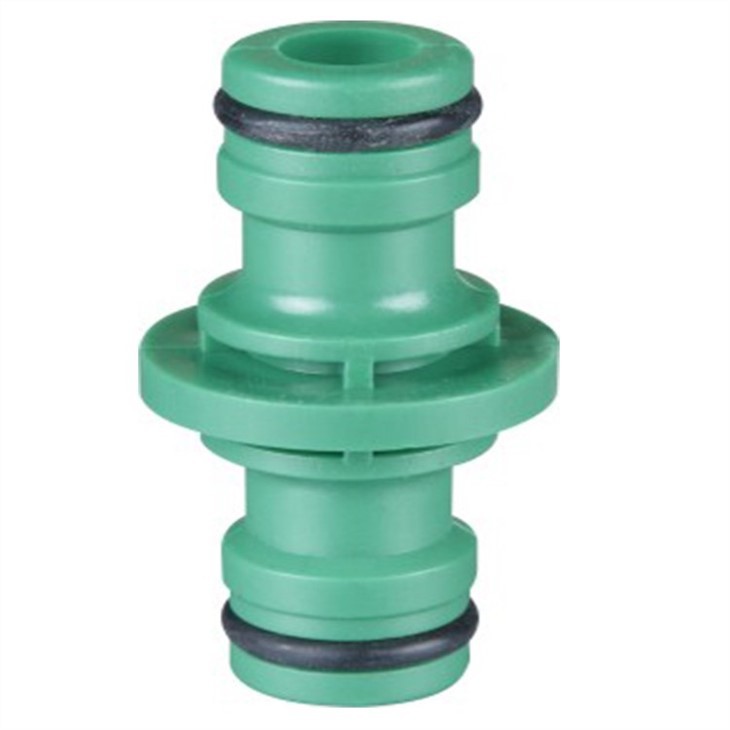
Choosing the right size of hose connector is crucial for maintaining optimal water flow. The internal diameter of the connector should match or be as close as possible to the internal diameter of the hose. This ensures that there is no unnecessary restriction or sudden change in cross - sectional area.
As a supplier, I always recommend that customers carefully measure the internal diameter of their hoses before selecting a connector. We offer a wide range of hose connectors in different sizes to meet the diverse needs of our customers.

2. Smooth Inner Surface
Connectors with a smooth inner surface can significantly reduce friction loss. High - quality materials such as brass or stainless steel are often used to manufacture hose connectors because they can be polished to a smooth finish. Additionally, some connectors are coated with special materials to further reduce friction and prevent corrosion.
3. Streamlined Design
A well - designed hose connector can minimize turbulence. Connectors with a streamlined shape, such as those with rounded edges and gradual transitions, allow water to flow more smoothly through the connection point. This helps to maintain a laminar flow and reduces energy loss.
Real - World Examples
Let's consider a few real - world scenarios to illustrate the impact of hose connectors on water flow.
Garden Hose Application
In a typical garden hose setup, a homeowner may use a hose to water their plants. If they attach a low - quality connector with a small internal diameter and a rough inner surface, they may notice that the water pressure at the end of the hose is significantly reduced. This can make it difficult to reach distant plants or to apply water evenly. On the other hand, using a high - quality connector that is properly sized and has a smooth inner surface can ensure a consistent and adequate water flow, making gardening tasks much easier.
Industrial Water System
In an industrial setting, where large volumes of water need to be transported at high pressures, the choice of hose connectors is even more critical. For example, in a manufacturing plant that uses water for cooling processes, a poorly designed connector can cause a significant drop in water flow, leading to inefficient cooling and potential equipment damage. By using high - quality connectors that are designed to minimize flow restrictions and friction loss, the plant can ensure reliable operation and reduce maintenance costs.
Our Product Range and Solutions
As a supplier of hose connectors, we understand the importance of providing products that have minimal impact on water flow. Our product range includes a variety of high - quality connectors designed to meet the needs of different applications.
- Water Dropper Set: This set is designed for precise water delivery, such as in drip irrigation systems. The connectors are carefully engineered to maintain a consistent water flow rate, ensuring that each plant receives the right amount of water.
- Hose Repairer: Our hose repairers are not only useful for fixing damaged hoses but also for maintaining optimal water flow. They are designed to fit snugly onto the hose, with a smooth inner surface and proper sizing to minimize flow restrictions.
- Two Way Connector: This connector allows you to split a single hose into two, enabling you to use multiple water outlets simultaneously. It is designed with a streamlined shape to prevent turbulence and ensure even water distribution.
Conclusion
In conclusion, hose connectors can indeed have a significant impact on water flow. Factors such as flow restriction, friction loss, and turbulence can all reduce the efficiency of a water system. However, by choosing the right size, material, and design of hose connectors, it is possible to minimize these effects and maintain optimal water flow.
As a supplier, we are committed to providing our customers with high - quality hose connectors that are designed to perform well and have minimal impact on water flow. Whether you're a homeowner looking for a reliable garden hose connector or an industrial user in need of heavy - duty connectors, we have the products and expertise to meet your needs.
If you're interested in learning more about our hose connectors or would like to discuss your specific requirements, please feel free to reach out to us. We look forward to the opportunity to work with you and help you find the perfect solution for your water flow needs.
References
- Munson, B. R., Young, D. F., & Okiishi, T. H. (2009). Fundamentals of Fluid Mechanics. John Wiley & Sons.
- White, F. M. (2011). Fluid Mechanics. McGraw - Hill.